What is a Medicare Flex Card? Explore Eligibility and What You Can Buy
There are a handful of different allowances that certain Medicare Advantage plans provide. These allowances are loaded onto pre-funded, limited-use cards—commonly called flex cards or OTC cards. Flex cards and OTC cards are only offered by some Medicare Advantage plans. They are never provided by Original Medicare. Allowance amounts and what you can use your flex card to buy vary by plan and individual situations.
This guide will explain all the details you need to know about flex cards: how to get one, what they can be used on, how the rules differ between plans and individuals, and how you can be sure a flex card offer isn't a scam.
Key highlights you should know
- Flex cards are offered and distributed by insurance carriers (like UnitedHealthcare, Humana, and Aetna).
- Flex cards can cover a variety of health and wellness items that you may get at a pharmacy.
- If you qualify for SSBCI, you may be able to use your flex card on things like utilities and groceries.
- While Medicare flex cards are a legitimate benefit, Medicare flex card scams exist. If you see an advertisement or receive mail about flex cards or free money for seniors from anyone but your insurance carrier, be careful.
What is a Medicare flex card?
Medicare flex cards are pre-funded benefit cards issued by Medicare Advantage insurance companies. They can only be used for eligible items and expenses. Eligible items and expenses vary by plan. They can also vary between different individuals.
The term "flex card" is an informal term. It's not used by Medicare or insurance companies, but has become a popular term to explain flexible benefit cards. Official Medicare documents will refer to specific benefits, like a meal benefit, transportation benefit, or over the counter (OTC) benefit. Insurance companies often have a special (potentially branded) name, like the UCard, Wellcare Spendables Card, Extra Benefits Card, or Spending Account Card. Each insurance company may use a different term for their benefit card, which is part of why the industry uses "flex card" or "OTC card" as general terms.
Is a flex card the same as your Medicare card?
Depending on your Medicare coverage, you may have one or more Medicare insurance cards. Below, we'll explain the different Medicare insurance cards someone may have and if they could be associated with a flex card.
Original Medicare red, white, and blue card
This is your main Medicare card issued by the federal government. It will state your name, your government-issued Medicare number, and Part A and B effective dates. Anyone on Medicare will have this card. It will never be tied to a flex card.
Medicare Supplement insurance card
If you are on Original Medicare and choose to enroll in a Medicare Supplement plan, you will receive a Medicare Supplement insurance card. Medicare Supplement plans will not provide flex cards.
Medicare Advantage ID card
This is the card issued by a Medicare Advantage plan. If you are on Medicare Advantage, you will present this card instead of your Original Medicare card at the doctor. In some cases, this card acts as a plan's flex card.
Medicare Part D plan card
If you have a standalone Part D (prescription drug) plan, you will have a card that goes with this plan. It does not act as a flex card.
Is a flex card the same thing as an OTC card?
People often use the terms "OTC cards" and "flex cards" interchangeably, and sometimes a carrier will have one benefit card that acts as both. That said, the specific benefits associated with each term are different.
As noted above, "flex card" isn't a standard term used by Medicare or insurance companies. In the industry and online articles, however, when someone is referring to an OTC card, that usually means the card can be used only for health and wellness items (like pain relievers, vitamins, oral hygiene products, first aid, and similar health products). When talking about a flex card, people are referring to a benefit card that can be used for the same products as an OTC card—and also other expenses like dental, vision, and hearing care costs, food, utilities, and transportation.
How do Medicare flex cards work?
Medicare flex cards work differently depending on your Medicare Advantage plan. The sections below cover how and when your allowances are loaded onto your flex card, how different allowances may be split, and what happens when you use the card.
When is money loaded onto a flex card?
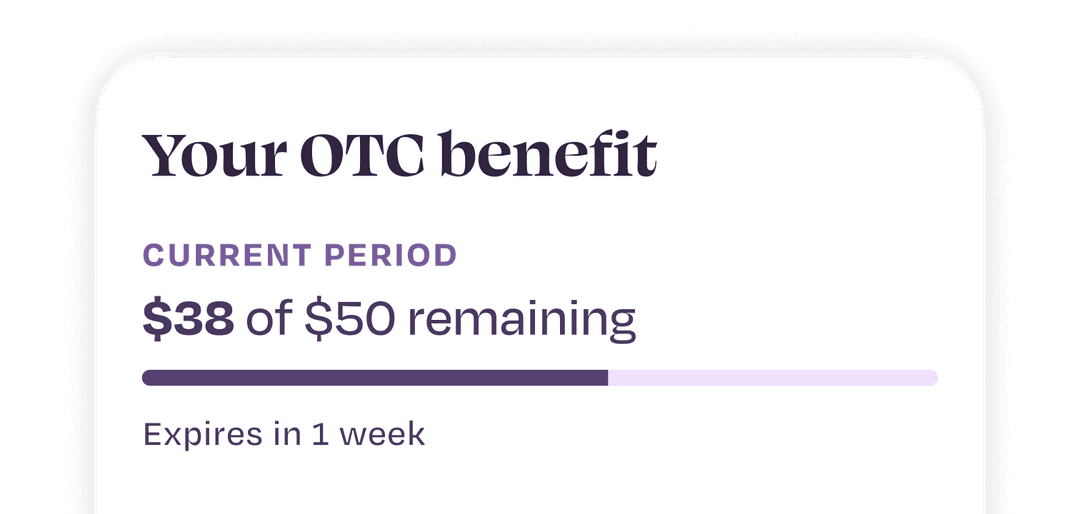
Medicare flex cards are auto-funded with relevant allowances based on your plan's benefit periods.
- Monthly: funds are added at the beginning of each month
- Quarterly: funds are added every three months
- Bi-annually: funds are added on January 1 and July 1
- Annually: the full benefit is available on January 1
Many allowances expire at the end of the benefit period, which is important to note because it could limit how you use your flex benefits. If your flex benefits do roll over, they will not roll over from one year to another—so always be sure to use your benefits before the last day of the year.
You can check your benefit periods, benefit amounts, rollover rules, and eligible items and expenses either via your insurance company's portal or on MyOTC.com.
How do Medicare benefit wallets work?
Because a flex card may hold a few different allowances (an OTC allowance, a grocery allowance, and a food allowance), allowances are divided into separate "wallets." When you go to make a purchase, funds will be pulled from the applicable allowance. If you do not have enough funds in one wallet, the purchase will be declined rather than being pulled from a separate wallet.
What happens when I use the card to pay?
When you use your card to make a purchase or pay a bill, several things will be checked in real time:
- Is the card activated?
- Is there an applicable wallet?
- Are there enough funds for the purchase?
- Is the merchant a participating merchant?
- Are the products or services eligible?
If the answer to any of these questions is no, then your card could be declined.
What can you buy with a Medicare flex card?
What you can buy with your flex card depends on your Medicare Advantage plan's specific benefits and if you qualify for SSBCI. SSBCI stands for Special Supplemental Benefits for the Chronically Ill. These are non-medical benefits (like allowances for healthy food, utilities, housing costs, and transportation) that are offered by some Medicare Advantage plans to help people with chronic illnesses. SSBCI is explained in more detail later in this guide.
Below are some of the different types of allowances (wallets) that your flex card may have.
| Wallet | What’s covered? | Eligibility |
|---|---|---|
| OTC allowance | Health and wellness items | Depends on your plan |
| Dental, vision, or hearing | Covered care and products | Depends on your plan |
| Healthy food allowance | Healthy food | Requires SSBCI eligibility |
| Utility allowance | Utility bills | Requires SSBCI eligibility |
| Transportation | Rides to places like grocery stores, banks, or church | Requires SSBCI eligibility |
| Housing | Rent or mortgage | Requires SSBCI eligibility |
| Home safety | Services to maintain a safe home, including home modifications or pest control | Requires SSBCI eligibility |
| Rewards | Plan-approved purchases | Requires completing activities specified by your plan |
What a flex card does not cover
Medicare flex cards will not cover the following:
- Alcohol
- Tobacco
- Non-healthy food
- General merchandise
- Cash or cash equivalents, like gift cards
What is SSBCI, and how does it affect flex card benefits?
As stated above, SSBCI stands for Special Supplemental Benefits for the Chronically Ill. These are non-medical benefits (like allowances for healthy food, utilities, housing costs, and transportation) that are offered by some Medicare Advantage plans to help people with chronic illnesses.
To be eligible for SSBCI, you must meet all of the following criteria:
- Have a qualifying chronic condition, which may include diabetes, cardiovascular disease, cancer, or chronic heart failure
- Have a high risk of hospitalization or adverse health outcomes as demonstrated by recent medical care
- Require ongoing care management coordinated by your healthcare plan or a medical provider
Where can I use a Medicare flex card?
Where you can use your Medicare flex card depends on your plan’s covered services and participating retailers. Below are the places your flex card should be accepted:
- Participating pharmacies and retailers
- Approved grocery stores
- In-network dental, vision, or hearing providers
- Online benefit catalogs
- Approved utility payment platforms
How much money do I get with a flex card?
How much money is on your flex card—and within specific wallets—depends on your Medicare Advantage plan. Benefits may be as low as $30/mo, but can be $1,200 or more.
How do I get a Medicare flex card?
Eligibility for a flex card is dependent on Medicare Advantage coverage. Because Original Medicare does not provide flex cards, you must enroll in a Medicare Advantage plan that offers a flex card in order to receive one.
Not all Medicare Advantage plans provide flex cards, and not every county has Medicare Advantage plans that include flex cards available.
Watch out for flex card scams
While flex cards are legitimate benefits offered by Medicare Advantage plans, there are many flex card scams and false advertisements out there. If you receive something about flex cards or OTC cards from someone other than your insurance company, your Medicare agent, or a reputable website, like My OTC, be careful.
Below are some red flags to watch out for:
- Calling it a "Senior" benefit card
- Referring to the flex card as free money
- Requesting your Medicare number
- Any pressure to act fast
- No website to look into
If you're unsure about something that mentions a flex card, reach out to a Medicare Advisor to confirm legitimacy.
Exploring Medicare Advantage plans with flex cards
Medicare Advantage allowances can provide people with tremendous value, but they should never be the top consideration when choosing your Medicare plan. Always be sure your Medicare coverage covers your doctors, prescriptions, and other healthcare needs first. Then, look at extra benefits, like OTC allowances, dental, vision, and hearing coverage, and other extras that could come with a flex card.
Frequently asked questions
Does Original Medicare offer a flex card?
No. Original Medicare does not offer a flex card, OTC card, or other allowances.
Is the Medicare flex card free money?
Medicare flex cards aren't necessarily free money because they have limitations. That said, they provide you with funds that can be used for certain expenses—so, many people refer to it as free money.
Can I use a flex card for groceries?
You may only use a flex card for groceries if your plan has a healthy food allowance and you qualify for SSBCI.
Can I use a flex card at Walmart, CVS, or Walgreens?
Many flex cards can be used at Walmart, CVS, and Walgreens, but participating retailers vary by plan. MyOTC.com is another option. It's a plan-agnostic website where you can use flex cards.
Do unused flex-card funds roll over?
Sometimes. Benefit periods and rollover rules vary between plans. Check your benefit via your insurance company's portal or on MyOTC.com.
Can a flex card pay rent or utility bills?
You can use your flex card to pay for rent or utility bills if your Medicare Advantage plan has these allowances and you qualify for SSBCI.
Does every D-SNP include a flex card?
No. Flex card benefits vary by plan. Check your plan's benefits via your insurance company's portal or MyOTC.com.